Roger Penrose (a prominent cosmologist) has a new idea about the universe: instead of starting outright with the Big Bang, the universe passes through an eternal series of aeons. Each aeon draws toward a close as all matter is sucked into black holes. The holes evaporate through Hawkings radiation, and the resulting evaporated particles then suddenly become massless and start travelling at the speed of light. At this point, from the particle perspective, space contracts to nothingness and time stands still, setting the stage for a new Big Bang.
Penrose’s theory diverges from Alan Guth’s prevailing inflation model, whereby the universe is a one-off result of a quantum fluctuation in nothingness which inexplicably inflated itself by a factor of 10E78 in 10E-32 seconds. The inflation is impelled by a still-undiscovered Higgs field through a process likened by Brian Greene to a frog hopping onto the ledge of a heated Bundt pan. Penrose reckons he can defeat Guth by detecting spherical ripples in the fabric of spacetime left over palimpsestically from the black holes of bygone aeons.
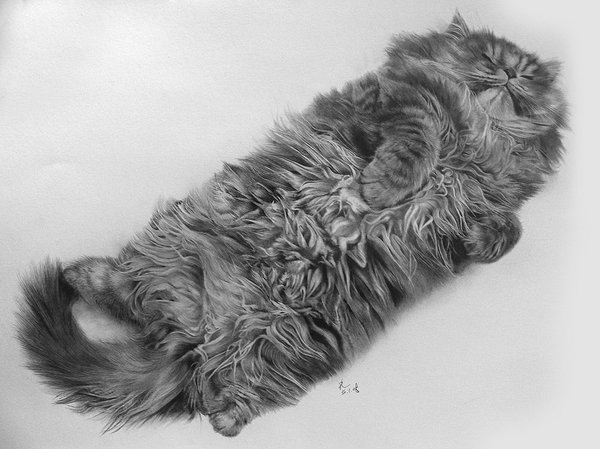
The truth is, it’s all pretty far out. I mean, which one seems more likely to you? It’s as though there’s one person telling you the universe is carried around on the back of a tortoise, but then someone else insists that no, it floats, having once been blown from the navel of an obese reclining man. – ?
What gets me though is that it still seems somehow profoundly important to my understanding of life. If the universe really is a one off, or is infinitely reincarnated, strikes me as pretty material to my figuring out how I feel about time, other people, consciousness, and what to take out of the fridge when I’m next standing in front of it. If one or the other of these theories is right, I need to know. Or I feel I need to know. Just like with whether or not there’s such a thing as a quantum of time, or if particles really are entangled in different regions of space. Obviously it’s not material at all, but I feel it is, at which point it instantaneously becomes material.
So the question I find myself asking is: is the impact of advances in cosmology and particle physics on a narrative-driven metaphor-rich human brain appropriate?